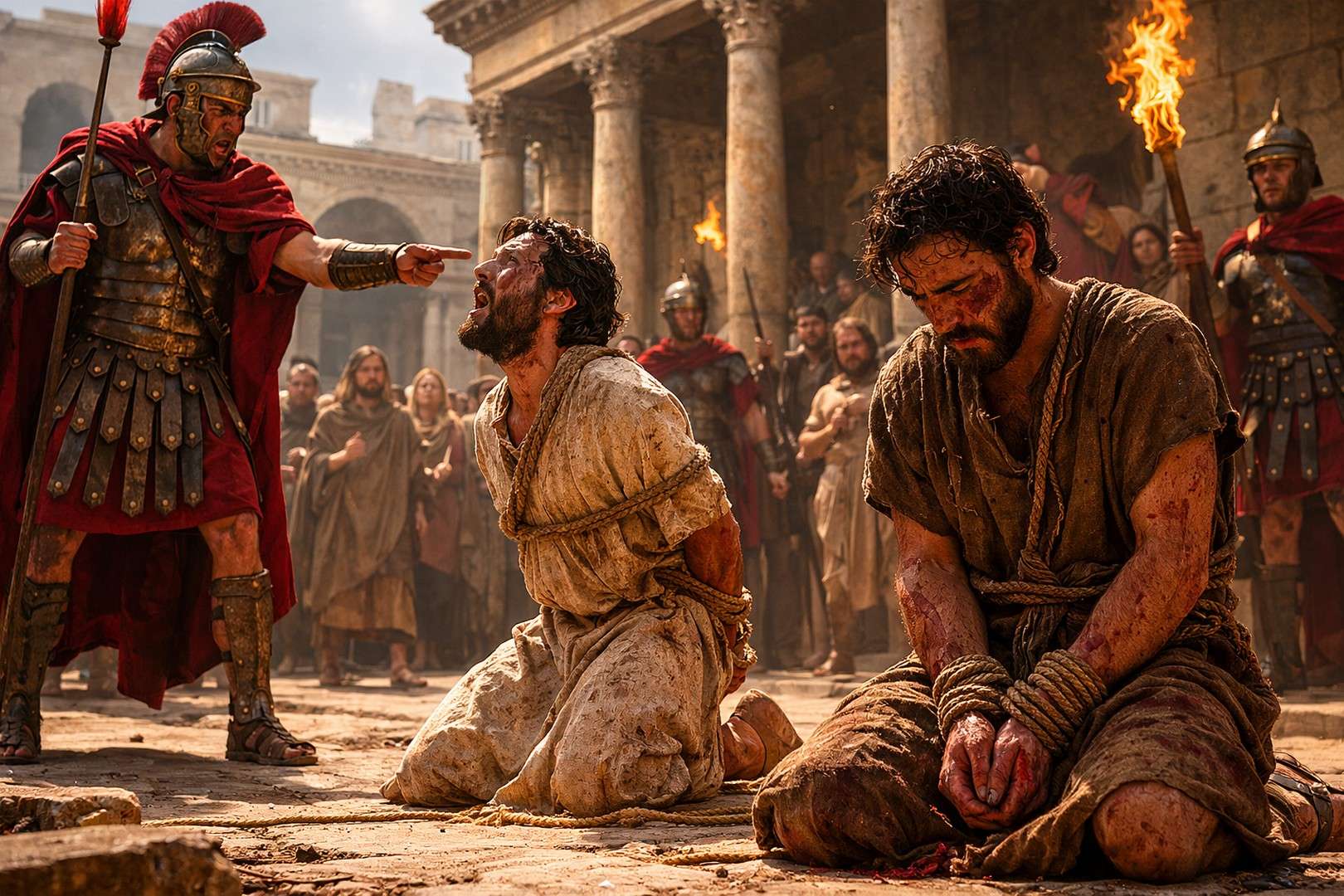
At the beginning of the fourth century, Christianity was spreading throughout the Roman Empire. But the empire’s fiercest and most violent persecution soon erupted, along with orders to destroy God’s Word. Authorities demanded that courageous church leaders like Philip (a bishop) and Hermes (a deacon), who were entrusted with the sacred Scriptures, relinquish their copies.
Edicts against Christians
Galerius, one of the Roman emperor Diocletian’s four rulers, persuaded him that Christians were a problem.
In 303, Diocletian issued a series of edicts against Christians: the destruction of church buildings, the burning of God’s Word, a ban on Christians serving in public office, and a mandatory sacrifice to the Roman gods upon penalty of death.
The worst persecution occurred in the province under Galerius’ charge, while the provincial capital of Heraclea, where Philip lived, remained relatively safe for Christians.
Heraclea (located west of modern-day Istanbul, Turkiye) was governed by an official named Bassus, whose wife was a Christian. At first his wife’s faith influenced his decision not to enforce the edicts, but in time, he yielded to pressure from Diocletian and Galerius.
Philip decides to stay
Church members, who knew persecution was imminent, urged Philip to leave the city. But Philip insisted on staying. “Let no threats, therefore, no torments of the wicked terrify you,” he told them. “For the Lord grants to his soldiers the reward of patiently enduring and suffering pain. For I believe that all their intention is in vain.”
A Roman official arrived to seal the doors of the church. “Do you believe that God dwells within walls, and not rather in the hearts of men?” Philip asked the official. Soon after the doors to Philip’s church were sealed, Bassus visited Heraclea and found Philip still gathered with Christians outside the church building. Bassus ordered him to hand over the church’s artifacts of gold, silver and any other metal or ornamental work. He also ordered Philip to surrender the church’s copies of the Scriptures. If he failed to comply, Bassus told him, he would be tortured until he did so.
“We will give you the vessels and treasure,” Philip replied, “for we do not worship God with precious metal, but with fear. But it is not fitting for me to give you the Scriptures.”
The torture
Bassus made good on his promise and ordered that Philip be tortured. A church deacon named Hermes, who was among those present, cried out, saying, “Even if we were to surrender to you all our Scriptures, so that there should be no traces left anywhere in the world, our descendants would teach yet more earnestly the fear that we owe to Christ.”
Hermes was also tortured, before being escorted by one of Bassus’ officials to the place where the Scriptures were kept. Officials then carried the Scriptures to the forum and threw them into an awaiting fire.
While Philip was in custody, Bassus tried to persuade him to offer sacrifices to the Roman gods, but he refused. Hermes also refused.
Bassus was still not prepared to impose the death sentence required by the edict. When his term in office ended, a new governor, named Justin, succeeded him. He also tried unsuccessfully to persuade Philip to sacrifice to the gods.
The sentence
In a cruel act, Justin had Philip dragged by his feet through the middle of the city. Christians carried his bleeding body back to his prison. Hermes also refused. So, Justin ordered that they be burned, that others may learn to obey.
Unable to walk because of his injuries, Philip was carried to the place of execution. Hermes, who also had difficulty walking, encouraged Philip while joyfully making his way to the place of execution. “Master,” he said, “let us hasten to go to our Lord. Why should we be concerned about our feet, since we shall have no more occasion for them?”
As the fire was lit, the two men began giving thanks; the word “Amen” was the last word heard from them.
In 305, Diocletian abdicated his rule as emperor. Galerius issued an edict in 311 ending the persecution. Despite their efforts to eradicate the Scriptures in the Roman Empire, God’s Word has prevailed throughout the centuries.
The unbroken chain of witnesses
The witness of faithful Christians who obeyed Christ even to the point of death inspires every generation. Their testimonies from throughout church history serve as a reminder that as members of the body of Christ, we, too, are called to be a part of the unbroken chain of witnesses.
Primary sources: “Passio Sancti Philippi” in Acta Martyrum by P. Theodorici Ruinart. The Historic Martyrs of the Primitive Church by Arthur James Mason. The History of the Christian Church, Volume 2, by Philip Schaff. The Story of Christianity, Volume 1, by Justo Gonzalez.
Source: VOM